

BRC Webinar Series
The Canadian Public Health Association through Immunize Canada is pleased to be partnering with the Bridge Research Consortium (BRC) on a series of webinars focused on supporting public trust and equitable access to vaccine and immune-based innovation in Canada.
Learn more about our partnership here: coming soon
Webinar Recordings
How religion influences vaccination decision-making in Canada: A case study of South Asian, Muslim, Sikh, and Hindu communities

This webinar explores the complex relationship between religion and vaccination decision-making in Canada, with a focus on South Asian Muslim, Sikh, and Hindu communities. The session highlights why religion should not be viewed as a single or isolated driver of hesitancy, but rather as one component interacting with individual, community, and structural influences – such as immigration status, education, and geography. The webinar will also showcase examples of community-led and faith-based initiatives that have supported equitable vaccine access and engagement in Canada. Haaris Tiwana will conclude with practical considerations for researchers, policymakers, and public health practitioners seeking to design more culturally responsive and equity-informed vaccination strategies.
Additional Resources:
- Bridging faith and public health to overcome vaccine hesitancy
- Vaccine Hesitancy Among Religious Groups: Reasons Underlying This Phenomenon and Communication Strategies to Rebuild Trust
- Enhancing faith and interfaith based facilitators and reducing related barriers to enhance vaccine acceptance: a qualitative study
- Effects of local faith-actor engagement in the uptake and coverage of immunization in low- and middle-income countries: A literature review
- Public-engagement strategies of the South Asian COVID-19 Task Force: The role of racialized healthcare workers in COVID-19 mitigation in Ontario
When innovation meets hesitancy: Building public trust in (mRNA) vaccines through dialogue

Research and vaccine development using mRNA technology enabled a rapid response to the new pathogen, SARS-CoV-2 early in the COVID-19 pandemic. Yet despite their scientific success, mRNA vaccines have been divisive, and public receptivity to vaccination has waned. This webinar will feature work underway through the BRC Dialogue Platform, drawing lessons from the mRNA COVID-19 vaccine experience to explore what it will take to build and sustain public trust in therapeutic innovations that play a pivotal role in limiting the scale and impact of harm from emerging pathogens. Dr. Plamondon will share highlights from the current dialogue series and reflect on how this responsive, collaborative approach to learning can itself help strengthen trust.
PARTICIPATE IN A DELIBERATIVE DIALOGUE:
If you are interested in participating in a Deliberative Dialogue, we would be happy to host you. Please reach out to us at equityscience.lab@ubc.ca
Navigating Moral Distress and Online Harassment of Health Care Workers
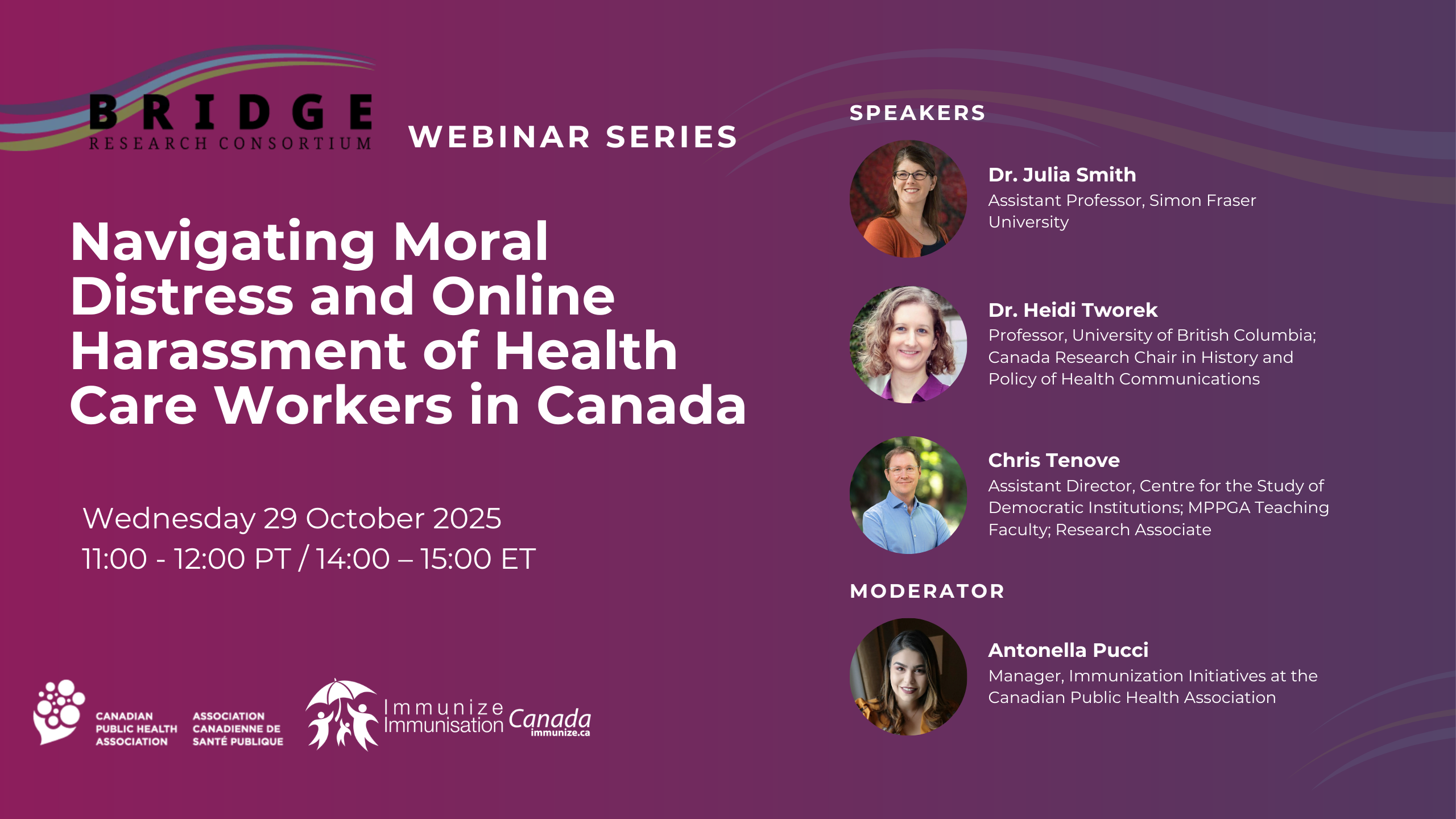
The COVID-19 pandemic exposed healthcare workers to intense ethical pressures and rising online abuse. In collaboration with the Bridge Research Consortium, this webinar will present research findings that capture the experiences of online harassment and moral distress—the inability to provide care one believes is ethically necessary due to external constraints—among healthcare professionals across Canada during the pandemic. The session will highlight evidence-based recommendations and resources developed in response to these challenges. Presenters will also introduce ongoing research aimed at better understanding how to support the healthcare community as it continues to navigate moral distress and online hostility, particularly in the context of vaccine hesitancy.
Learning Objectives:
- Explore the experiences and impacts of moral distress and online harassment on healthcare professionals in Canada from the COVID-19 pandemic to the present
- Identify strategies to reduce and prevent online abuse and harassment
- Contribute to ongoing efforts aimed at supporting healthcare workers navigate moral distress and online harassment amid rising vaccine hesitancy.